
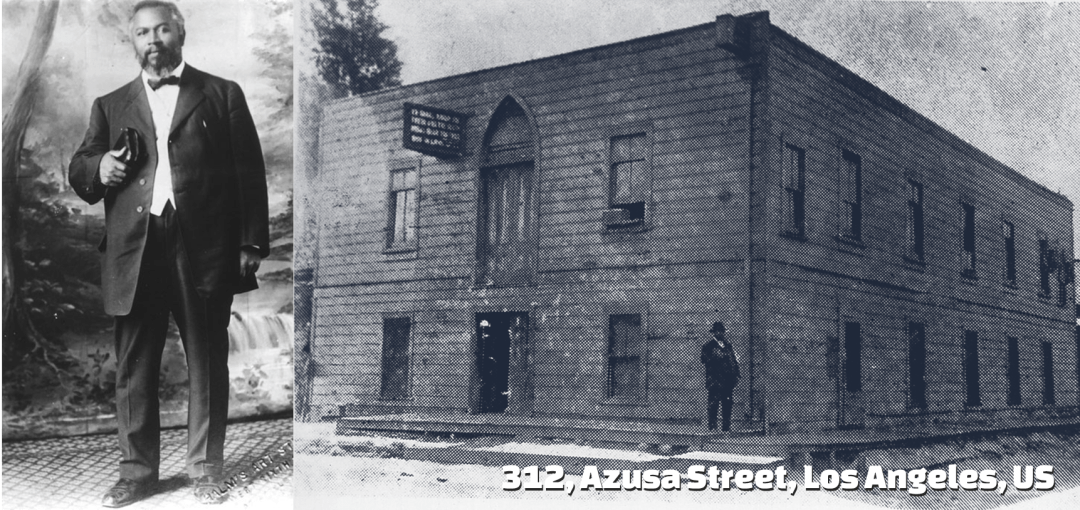
I want to share about William J. Seymour, the African-American evangelist whom God used mightily during the great Azusa Street Revival. Just like in the days of Pentecost, it was recorded that the tangible glory of the Lord was revealed through the Holy Spirit to many people. God’s presence came down in power, and lives were transformed.
During those meetings, many gave their hearts to Jesus, countless people received miraculous healings, and there were undeniable demonstrations of God’s glory and power. The name of the Lord was lifted high, and from that humble gathering in Los Angeles, the fire of revival spread across the world.
Let me give you a brief summary of the revival—it’s such an amazing story! In the write-up below, the sentences in bold are my emphasis.
“William J. Seymour, an African-American, was born on May 2, 1870, in Centerville, Louisiana, to former slaves Simon and Phillis Seymour, who raised him in the Baptist faith. Later, while living in Cincinnati, Ohio, Seymour encountered the holiness teachings of Martin Wells Knapp’s God’s Revivalist movement and Daniel S. Warner’s Church of God Reformation Movement, also known as the Evening Light Saints.

Believing they were living in the last days of human history, many Christians of the holiness movement expected that the outpouring of the Spirit would come before the rapture of the Church. These teachings left a deep impression on the young William J. Seymour.
After moving to Houston, Seymour began attending a local African American holiness congregation pastored by Lucy F. Farrow, who had once served as a governess in the household of Charles F. Parham. Parham, who had led the Midwestern Apostolic Faith Movement (the original name for the Pentecostal movement), first taught on the baptism of the Holy Spirit at his Bethel Bible School in Topeka, Kansas, in 1901. By 1905, Parham had relocated to Houston, where he conducted revivals and opened another Bible school. Farrow arranged for Seymour to attend Parham’s classes. Yet because of the segregation laws of the time, Seymour was forced to sit outside the classroom door, listening to the lectures from a distance.
Despite this, Seymour embraced Parham’s teaching on the baptism of the Holy Spirit—specifically the belief that speaking in other languages (“tongues”) was the Bible’s evidence of Spirit baptism, given for missionary evangelism.
In 1905, Neeley Terry, a member of a congregation in Los Angeles led by Julia W. Hutchins, visited Houston and heard Seymour preach. Deeply impressed, she recommended him to Hutchins, whose church was seeking a pastor. With financial help from Parham, Seymour traveled by train to Los Angeles in February 1906. Later he recalled:
“It was the divine call that brought me from Houston, Texas, to Los Angeles. The Lord put it on the heart of one of the saints in Los Angeles to write me that she felt the Lord would have me come there, and I felt it was the leading of the Lord. The Lord provided the means and I came to take charge of a mission on Santa Fe Street.”
On his very first Sunday morning sermon, Seymour preached boldly from Acts 2:4, teaching that speaking in tongues was the true evidence of baptism in the Holy Spirit. He declared that without this evidence, no one could claim to have received the baptism. This teaching, however, clashed with the established holiness view that sanctification and Spirit baptism were the same experience. Seymour’s sermon unsettled Hutchins so much that by the evening service, the church doors were padlocked against him.
Providentially, Seymour had been invited for lunch that day at the home of Edward Lee, a member of the Santa Fe Mission. Seeing Seymour turned away and homeless, Lee offered him a place to stay. Seymour devoted much of his time there to prayer and fasting, gaining a reputation as a man of unusual prayerfulness. Lee and his wife began to join him in these prayer sessions, and soon other members of the mission followed, despite Hutchins’ objections.
Seymour was later invited to minister at a small home Bible study and prayer meeting at the home of Richard and Ruth Asberry, at 214 North Bonnie Brae Street. Beginning in February and continuing through mid-April 1906, these meetings were first attended by a small group—mostly African American washwomen and their husbands.
Though Seymour himself had not yet experienced speaking in tongues, he preached faithfully with great conviction, believing the promised blessing was near. Word of the meetings began to spread, and by late March, white believers had joined the group at Bonnie Brae Street, seeking the same baptism of the Spirit. Recognizing the spiritual influence of his longtime friend Lucy Farrow, Seymour invited her to Los Angeles. She arrived after the group had set aside ten days of fasting and prayer.
Then, on the evening of Monday, April 9, 1906, the breakthrough came. Earlier, Edward Lee had shared a vision in which the apostles explained to him how to speak in tongues. That evening, before going to the Asberry home, Seymour prayed with Lee, who asked to receive the baptism of the Holy Spirit. As they prayed, Lee was filled and immediately began speaking in other tongues. This became the very first instance in Los Angeles where someone received the baptism with the Holy Spirit under Seymour’s ministry.

Rushing to the meeting at the Asberry home, Seymour related what had just happened to brother Lee to the packed meeting. (I’m sure this sounds familiar to what most of us would have done. Me tThat same evening, April 9, 1906, Seymour went on to the prayer meeting at the Asberry home on North Bonnie Brae Street. As the group gathered for worship, something extraordinary happened. During the meeting, Jenny Evans Moore, who would later become Seymour’s wife, suddenly fell to the floor under the power of the Spirit. She began speaking in tongues and later sang in an unlearned language, described by witnesses as heavenly. Soon, others in the room were also filled with the Holy Spirit and began speaking in tongues.
The small house could barely contain the crowds that came once news of these events spread. Neighbors gathered outside, and even people passing by on the street stopped, drawn by the sound of loud praying, singing, and supernatural manifestations. So many came that the wooden porch of the Asberry home eventually collapsed under the weight of the people. No one was hurt, but it became clear that a larger meeting space was needed.
Within days, the revival moved to a rundown former African Methodist Episcopal church building at 312 Azusa Street in Los Angeles. The humble structure, previously used as a stable and warehouse, became the unlikely center of a spiritual outpouring that would shake the world.
Inside, the atmosphere was simple and unpolished. Crude wooden planks rested on nail kegs for pews, and the pulpit was nothing more than a few wooden boxes stacked together. Yet in that humble setting, seekers from every background—men and women, rich and poor, Black, white, Latino, and immigrant—came together in unity to encounter God. This was radical in a deeply segregated America.
Eyewitnesses testified that God’s glory filled the meetings. People fell under conviction of sin, repented, and gave their lives to Christ. Others experienced miraculous healings. Still others received the baptism in the Holy Spirit and spoke in tongues. One reporter even described a visible cloud of God’s presence resting in the building, with children playing in it as though it were tangible.
Seymour rarely pushed himself to the front. Often he was seen praying with his head hidden inside an empty wooden crate at the front of the room. His humility, faith, and focus on Jesus set the tone for the entire revival. Services ran day and night, seven days a week, with no formal schedule—yet God moved powerfully in every gathering.
From this humble mission on Azusa Street, the fire of Pentecost spread across the United States and around the world. Missionaries carried the message of Spirit baptism and the gifts of the Holy Spirit to Africa, Europe, Asia, and Latin America. The Azusa Street Revival (1906–1909) is now recognized as the birthplace of the modern Pentecostal and Charismatic movements, impacting hundreds of millions of believers worldwide.
God came in great waves of power and refreshing.

The doors and windows of the Asberry home were thrown open as the prayer meeting overflowed. “They shouted three days and nights. It was Easter season. People came from everywhere. By the next morning, there was no way of getting near the house. As people came in, they would fall under God’s power, and the whole city was stirred. They shouted until the foundation of the house gave way, but no one was hurt.”
Meetings at the Bonnie Brae house went on day and night for at least three days. Eyewitnesses reported people falling under the power of God and receiving the baptism of the Holy Spirit with the evidence of speaking in tongues—even while listening to Seymour preach from across the street. The crowds quickly grew so large that the house could no longer contain them. The press of people trying to get inside was so intense that the front porch collapsed into the steep yard, yet miraculously no one was injured. Within a week, it became clear that a larger location was necessary. The group soon rented a vacant building at 312 Azusa Street—a humble structure that would become the center of a global revival.
Manifestations of the Azusa Street Revival
A reporter later described the meetings:
“Suddenly the Spirit would fall upon the congregation. God himself would give the altar call. Men would fall all over the house, like the slain in battle, or rush for the altar en masse to seek God. The scene often resembled a forest of fallen trees. Some claim to have seen the Shekinah glory by night over the building.”
He also noted the remarkable singing:
“Especially did the enchanting strains of the so-called ‘Heavenly Choir’—hymns sung under the evident direction of the Holy Spirit, both as to words and tune—thrill my whole being. It was not something that could be repeated at will, but supernaturally given for each special occasion. Perhaps nothing so greatly impressed people as this singing, which inspired holy awe and indescribable wonder.”
Love was the central theme of Azusa. One participant testified:
“Divine love was wonderfully manifest in the meetings. They would not even allow an unkind word against their opposers or other churches. The message was always ‘the love of God.’ It was like the ‘first love’ of the early church returned. The baptism we received did not allow us to think, speak, or hear evil of any man. The Spirit was very sensitive—tender as a dove.”
Another said:
“I would rather have lived six months at that time than fifty years of ordinary life. I have stopped more than once within two blocks of the place to pray for strength before I dared go on. The presence of the Lord was so real.” Many people fell to the ground under God’s power in the streets before even reaching the mission. Some rose speaking in tongues, never having stepped inside. Scores of eyewitnesses also told of skeptics who came to ridicule but were struck to the floor, struggling as though wrestling unseen forces for hours, only to rise convicted of sin and seeking God. One foreign-born reporter, sent to mock the meetings, attended a night service. He heard a young woman testify in English but suddenly break into tongues. Afterward, he approached her and asked where she had learned the language of his native country. To his astonishment, she told him she spoke only English. Yet she had delivered, in perfect detail, an account of his sinful life in his mother tongue—a message that cut him to the heart.

Eyewitnesses reported seeing a holy glow radiating from the Azusa Street Mission, visible from blocks away. Others described hearing sounds like mighty explosions echoing through the neighborhood, causing alarmed residents to call the Fire Department, believing the building was on fire. On several occasions, city agencies tried to intervene: the Child Welfare Agency attempted to shut the meetings down because children lingered in and around the building at all hours, while the Health Department complained that the crowded and cramped conditions were unsanitary. Yet none of these efforts could stop the hungry multitudes who pressed their way in, desperate for more of God.
From that humble wooden building, men and women were soon departing as missionaries to Scandinavia, China, India, Egypt, Ireland, and many other nations. Even Sister Hutchins—who had once padlocked Seymour out of her church—came to Azusa, received the baptism of the Holy Spirit, and went forth to Africa.
The revival drew notable Christian leaders as well. John G. Lake, who later became a renowned missionary to South Africa, wrote of Seymour:
“He had the funniest vocabulary. But I want to tell you, there were doctors, lawyers, and professors listening to the marvelous things coming from his lips. It was not what he said in words—it was what came from his spirit to my heart that showed me he had more of God in his life than any man I had ever met up to that time. It was God in him that attracted the people.”
A Cry for Our Day
Lord, our cry is that You will daily fill us with Your mighty Spirit in this age! Draw men and women to Yourself by Your power. Bring healing to the broken, comfort to the weary, provision to the needy, and deep intimacy with You to all Your people. Do what is impossible for man—turn hearts back to You. Come, Lord, and fill us afresh with the fire of Pentecost!
God be praised forever and ever!
Culled from Shiloh Trenton: William Seymour and the History of the Azusa Street Outpouring by Tony Cauchi (2004)
Scriptural References & Call to Action from the Azusa Story
1. Hunger for God’s Spirit
- “Blessed are those who hunger and thirst for righteousness, for they shall be filled.” — Matthew 5:6
- The believers at Bonnie Brae and Azusa prayed, fasted, and waited for the promise of the Spirit just as in Acts 1:14.
Call to Action: Ask God daily to stir a fresh hunger in your heart. Set aside time for prayer and fasting, believing He will fill you.
2. Unity in the Spirit
- “For by one Spirit we were all baptized into one body—whether Jews or Greeks, whether slaves or free—and have all been made to drink into one Spirit.” — 1 Corinthians 12:13
- At Azusa Street, people of every race and background worshiped together in unity, breaking cultural barriers.
Call to Action: Pursue love and unity in the body of Christ. Lay aside prejudice, pride, and division, and welcome all who call on the name of Jesus.
3. The Power of the Holy Spirit
- “But you shall receive power when the Holy Spirit has come upon you; and you shall be witnesses to Me…” — Acts 1:8
- At Azusa, ordinary men and women were empowered by the Spirit and sent as missionaries across the world.
Call to Action: Invite the Holy Spirit to empower your life for service. Say, “Here I am, Lord, send me” (Isaiah 6:8). Be willing to step out in boldness to share Christ.
4. Signs and Wonders Glorify God
- “And they went out and preached everywhere, the Lord working with them and confirming the word through the accompanying signs.” — Mark 16:20
- Eyewitnesses at Azusa reported healings, miracles, prophetic words, and supernatural singing that brought awe and glory to God.
Call to Action: Pray in faith for God to demonstrate His power in your life, family, and community—not for show, but so that Christ will be glorified.
5. Living in Holiness and Love
- “Pursue peace with all people, and holiness, without which no one will see the Lord.” — Hebrews 12:14
- “By this all will know that you are My disciples, if you have love for one another.” — John 13:35
- Testimonies from Azusa emphasized a baptism of love that refused to speak evil of any person.
Call to Action: Let the Spirit cultivate gentleness, meekness, and love in your heart (Galatians 5:22–23). Guard your words and actions so they reflect Christ’s character.
6. Revival for Today
- “Will You not revive us again, that Your people may rejoice in You?” — Psalm 85:6
- Just as God shook Los Angeles in 1906, He desires to revive His church today.
Call to Action: Pray earnestly for a new outpouring of the Spirit in your family, church, and nation. Say: “Lord, do it again in our time!”
Closing Exhortation:
The story of William J. Seymour and the Azusa Street Revival reminds us that God uses the humble, the hungry, and the prayerful. The same Spirit who fell at Pentecost and at Azusa still moves today. Will you yield your life fully to Him, walk in love, and be a vessel for revival?

 Home!
Home! 
One thought on “Azusa Revival: The Move of the Holy Spirit”